Case Study: Ancestor Identity Crisis

For years my paternal first cousins got nowhere with attempts of identifying with validation who the parents were of a great-grandfather I will identify as Henry.  I was up for the challenge and began with looking at family trees created by DNA match first cousins.  A number of them identified the parents, William and Ottilie.

I was interested in going back to William and Ottilie’s origins before they emigrated to the Wautoma, Wisconsin, area where they married, lived and died.  The research process started with locating the couple’s obituaries to get some idea who their children were.  

I was able to get this information both online (Ancestry.com, MyHeritage.com, FamilySearch to name a few) and through a library from the Wautoma area.  The librarian was very helpful in locating obituaries that GenealogyBank.com didn’t have, including those of the couple’s children.

I recorded my findings on family group sheets, hourglass charts and Google Drive documents and spreadsheets, citing sources along the way.  But, the information from obituaries for William and some of his children didn’t really add up.  

First, William arrived in Wisconsin in 1870 without Henry.  Henry arrived in 1900, not in Wisconsin, but in Canada and then crossing over the border to live in North Dakota.  It appeared that William and Henry didn’t have any contact over the years.  Henry wasn’t mentioned as one of William’s children in his obituary nor was he mentioned in obituaries of William’s children as a sibling.  

I wondered if the intent was for Henry to join William and the rest of the family years later for some unknown good reason or if they somehow lost contact with each other.  I examined vital records and other documents.  I couldn’t find anything useful to make any sense.

I moved on to making connections with second cousins who I got to know over time from Ancestry and then via Facebook.  I created a private Facebook group for both first and second cousins for collaboration.  Some cousins were told Henry came through Ellis Island before arriving in North Dakota.  Others didn’t know Henry well enough, having been too young to know more than what their parents told them.  

Family history books may have existed, I was told, but they were either sold or stolen.  Anyone who knew anything was dead.

Months later, I circled back to looking at DNA matches on Ancestry.  I wanted to give ThruLines a chance to work with a DNA tree I created for William and Ottilie.  I had only one DNA match connection to Ottilie and none for William.  Shared matches of my cousins didn’t include this match or any matches for that matter for either William or Ottilie.

I went back to “doing the genealogy” by studying locations of where William and Henry lived before arriving in the United States.  William was part of the German immigrant group known as Prussian Netzelanders based on a book compiled by genealogist Brian A. Podoll, C.G.R.S.  This group settled in the Wautoma area.  

One of my cousins indicated he thought Henry’s origins were Prussian, but I could not find any evidence to validate this thought.  Henry’s naturalization documents indicated that he was not born in a location under Prussian authority at the time of his birth.  Far from it.  Census records for Henry showed Henry didn’t come from Prussia either.  

A month later after trying every research trick I knew and looking at William’s children’s vital records, I pursued collateral research amongst William’s siblings.  This led to contact with someone who was not a DNA match but whose Ancestry tree included William’s family.  She was someone I knew from a Facebook genealogy group I belong to as well.

She took a look at my working trees on Ancestry and compared them to her tree, which turned out to actually be her husband’s.  After a lengthy conversation it was concluded that William and Ottilie had no connection at all to Henry.  

At this point, after learning from cousins that they had no idea how it was that this couple were Henry’s parents and added to Ancestry trees, I abandoned further research on them.  I removed them from working trees and my main tree.  

It was confirmed a month later (by now a total of 7 months of research) by another connection I made that this couple were not related at all to Henry.  So, the next question was, who really were Henry’s parents?

Some people may say I wasted 7 months of time only to find William and Ottilie were not Henry’s parents.  But, I didn’t see it that way.  I got the opportunity to put into practice skills that brought me closer to becoming an intermediate level genealogist.  

Lesson learned:  Do not take at face value what someone else has on a family tree.  Do the genealogy!

How I Manage Genealogy Research

For months as I got into my genealogy research projects, I had been searching for the best, maybe even the ONLY way to organize my digital files and paper.  I purchased books and courses and viewed online articles and videos.  They had different ways of doing it with some ending up with the same result.  

This should have made making a decision about which way to do it easy, especially if the process came from a genealogy expert.  Right?

Uhh…no.  

Though one specific method or process works for some, it doesn’t for others.  If anything, all of that advice from genealogy experts can be downright overwhelming.

Ultimately, here’s how I manage my genealogy research:

Digital

  • Research logs and reference resources in the form of Google Docs and/or PDFs are kept in Google Drive.
  • Trackers for DNA matches, surnames, census data, citation logs, logs of where photos and other genealogy-related files are kept and other types of genealogy-related charts in the form of Google Sheets are kept in Google Drive.
  • Photos and other genealogy-related digital files are kept in multiple places:
    • Electronic files organized in folders and subfolders on my main genealogy laptop’s hard drive which are backed up on 
    • The Seagate Photo Drive
    • Albums created based on ancestor in my ForeverⓇ storage account.
    • Genealogy software

Paper

At the start, I found this 13-step color-coded filing system for Ancestry research to be helpful:  https://beginmystory.com/13-step-color-coded-filing-system-ancestry-research/  This system proved to be a simple way to start organizing genealogy papers.

I ended up using up some jewel-tone Pendaflex hanging folders and file folders I had lying around rather than using the red, yellow, green and blue folders suggested in the Begin My Story article.  I just adapted what I had to that system and kind of tweaked it to what worked for me.  

  • Family group sheets, pedigree charts and printed-out items of interest are kept in paper  files of different colors to distinguish families.
    • These files are kept in IRIS desktop paper file organizers by family on wire shelving units.  
    • Labels are attached to the IRIS desktop paper files front and side so that they can be easily identified at a glance.
  • My main working research project on an ancestor is kept in a binder.
    • Papers may include working family group sheets, pedigree charts and printed-out online articles and maps, email correspondence and anything else pertinent to the ancestor.  Some of these are kept in sheet protectors if they require a lot of handling.  
    • This binder is kept on my workspace desk to use during active research.  It can also be placed in one of my project desktop containers if I need to clear the workspace to work on something else.
    • Later, these can be transferred to the ancestor’s paper file upon project completion.
  • Working research projects in progress are also kept in separate binders to distinguish families.  The binder is kept in an IRIS desktop paper file organizer for that family until it becomes the main working research project.  File folders are not yet created at this point.  The paper kept in the binder includes printed out incidental findings that come via new DNA match information or delayed messages from genealogy websites.  
  • Reference material coming from online article print-outs or course hand-outs is kept in separate binders to distinguish genealogy-related topics.  Examples:
    • Reference with topics divided into sections using binder dividers with labeled tabs
    • Location/Language with locations and the languages associated with the location divided into sections
    • People – religions and ethnicities divided into sections
  • Books and magazines are kept on shelves with magazines placed in desktop magazine holders that fit the shelves.  Books used for a research project are kept separate from the rest on a different shelf.

As you can see, when information and records are coming from different places and are in different stages of a genealogy research workflow process, they require a number of storage locations.  It took me a while to figure this out through trial and error.  

I can’t tell you that my way of managing genealogy research is THE best way.  But, here is what I learned that I can pass on to you:

  • Genealogy research management depends on your own personal genealogy workflow.  Identifying your workflow process is key and the first step you should take.  Then, build your own management system based on what works for you.  
  • Once you have your management system created, be consistent with its maintenance.  Put digital and paper where they belong right away.  Back up digital files on a schedule.

How To Use Reverse Genealogy With DNA To Identify Living Descendants: Step 3

Without making a connection with potential second cousins or their descendants, you won’t be able to get the full benefit of collateral research to have a chance at breaking through your genealogical brick wall. Instead, you’ll continue to be stuck.

Let’s Get Started

The best way to get started is to determine which of your DNA matches would be the best candidates to contact.  Remember that spreadsheet I created back in Step 2?  This is when you can really make use of it!  At a glance you can see who is related to who, who is alive and how best to make contact.  

Start with contacting your DNA match at the site where they got tested.  I discovered that Ancestry’s user profiles show when a user last accessed their account and how often they do. A match who uses Ancestry daily is more likely to see your message than one that hasn’t been online for months.  If that site is the only way to make contact, then go for it.  

Keep your message brief.  Don’t elaborate a lot about yourself.  Start out telling them it’s good to meet them there at the testing site.  Share that you have been working on learning more about a certain ancestor.  Let them know you think they could help.  

Then, just simply state you are looking for anything on a particular surname and location.  If you have a particular question, just simply ask it.

To get them to respond, just end asking them to let you know they got your note even if they don’t know the answers.  

Be sure to make note of this contact.  I enter this information on the Google sheet.  I include the testing company website name and date I sent the note.  

Sometimes, I take this one step further.  If I find that the match is on Facebook, I drop them a Facebook messenger chat note.  I only do this if I have the match’s full name and I have enough info on the match to know I have the right person.  

I’ve also reached out to a match’s child or sibling on Facebook especially if I see that the match isn’t that active on Facebook either.  I’ve been fortunate that the responses I get are positive.  

I briefly introduce myself as a DNA match from the testing company, letting them know I left a message.  You don’t have to do this.  But, it may be helpful if the match doesn’t check their testing company’s account often.  

If you don’t get a response, then know you didn’t miss an opportunity to reach out.  Sometimes, a match will respond months later.  That’s why it’s important that you don’t just settle for one match to connect with. 

In Conclusion . . .

Applying reverse genealogy to DNA using collateral research is helpful for:

  • Determining which cousins beyond first cousins can provide useful information for busting through a brick wall.
  • Figuring out how DNA matches are related.

How To Use Reverse Genealogy With DNA To Identify Living Descendants: Step 2

After you evaluate records and sources that provide names of the ancestor in question’s relatives, the next step is to do some online research.  You may have names of relatives who may be alive.  But, you need to find out where they are in the present.  They could have moved from the location listed in an obituary, for example.  

You can try out online resources listed below.  But, do not fall for prompts on some of the people finding websites for you to purchase information.  These websites are created by data brokers who make money off of selling information.  Details from a search can give you information like a name, birth year and age, other names associated with the person, people’s names who may be family or acquaintances, addresses and phone numbers.  

Be cautious with pop-ups from websites and fill-in blanks created by BeenVerified.com on some of the websites.  Just get what you can for free and move on. 

Online Resources

  1. Google https://google.com/ 

A great place to start by typing in the person’s name in the search bar.  This may lead you to other online sites like online directory pages listed below.

  1. PeopleFinders  https://www.peoplefinders.com/

Though you can find public records from websites dedicated to genealogy, you can find them on this website if you have a name and some idea of location.  

  1. White Pages https://www.whitepages.com/

If you have a name and location, WhitePages.com is a good resource.  You may be able to find out contact information like a phone number or email address.

  1. Intelius  https://www.intelius.com/ 

This website claims that it is “your go-to resource for finding people.”  Intelius claims that it updates their “people search engine in an effort to provide you with accurate and robust information.”  

  1. FamilyTreeNow https://www.familytreenow.com/

This website is known as a free option to finding living relatives.  Their mission is “to create the best free genealogy site in the world.”  They claim to have living people records in their database.  Just click on a surname.  You can pull up records of various types including those for the living.

  1. Cyndi’s List 

Check out the Finding Living Relatives list on Cyndi’s List for telephone directories https://www.cyndislist.com/finding-people/telephone-directories/ 

  1. Facebook

This is a wonderful place to look for living relatives.  I’ve discovered that it validates I’m on the right track with who is related to whom and if I have the right person.

As you explore these online resources, be sure to record your findings.  You can do that in a research log, but I created a tool to help me visualize what I found better.  

I created a Google sheet in my Google Drive to record match information as I worked through this step.  Here is what it looks like:  

Regardless of how you record your findings, it is important that you take the time to do it.  You will need this documentation for the next step. 

In Conclusion . . .

Finding living relatives using the resources listed above takes you one step further in collateral research.  Read about the next step, making connections, in the next post.

How To Create A DNA Match Tracker

In my post about using reverse genealogy with DNA (Step 2), I told you about a tool I created to record DNA matches discovered during online collateral research.

I will share with you how I created this tool that I call a living family tracker.  The tracker lives in my Google Drive as a Google sheet. 

Here’s How

Step 1:  Create and name a new spreadsheet

  • Open the Sheets home screen at https://sheets.google.com/ 
  • Click New +.  This will create and open your new spreadsheet.
  • At the top of the page, click Untitled spreadsheet and enter a new title.
    • Surname Living Family Tracker or 
    • Surname DNA Match Tracker

Step 2:  Create column titles on line 1.  This will serve as your header row with columns.

  • Column A:  Name
  • Column B:  Cousin Type
  • Column C:  Parent
  • Column D:  Status of D or L
  • Column E:  Contacted
  • Column F:  Resource Info

Step 3:  Freeze line 1 to keep it in the same place when you need to scroll through the spreadsheet.  On the menu bar, click View > Freeze > Up to row 1.

Step 4:  Record your descendants and/or DNA matches.

  • Name:  Name of descendant (first and last)
  • Cousin Type:
  • Parent:  The name of the descendant’s parent.
    • Example:   Name is Jean.  Her cousin type is 1C1R.  Her parent would be Erin, who is your first cousin.   
  • Status D or L:  Indicate D if person named is deceased or L if person named is living.
  • Contacted:  Indicate Yes if you contacted the person named or No if you didn’t contact the person named yet.
  • Resource Info:  Indicate where you found the person named online.  You can add other comments to it like how the person is related to someone else.
    • Example for living:  23&Me & Facebook; half sister of X X.
    • Example for deceased:  GenealogyBank obit; DNA match.

In Conclusion . . .

You can create the same spreadsheet if Excel is what you’re comfortable using.  If you prefer an offline approach, creating a chart on paper will work too.  What matters is that you have a place to record your findings as you do collateral research online.

How To Use Reverse Genealogy With DNA To Identify Living Descendants: Step 1

It was May 2023.  I had just finished the DNA Skills Workshop.  I figured out who the main players were of my DNA matches from Ancestry and a few from 23&Me.  But, I was eager to bust through a genealogical brick wall that my newly found first cousins were trying to break through for years.  

I came up with a strategy to identify DNA matches beyond first cousins formally known as reverse genealogy.  These matches had to be second cousins, since the brick wall was the inability to identify the parents of a great-grandfather.  

I thought reverse genealogy, which is doing a search for descendants of a person, dead or alive, would provide me with some clues.  With the brick wall where it was, I couldn’t dig any further into the past.  I decided to start digging toward the present.

If you really want to get technical, doing reverse genealogy leads to what is called cluster research.  The goal of cluster research is figuring out which descendants may have records or information you don’t have.  In this case, “which descendants” were second cousins or the children of the children of the great-grandfather. 

There are 3 steps to my reverse genealogy/cluster research approach:  

  1. Evaluating records and sources that provide names of people related to the ancestor in question.
  2. Doing some online research based on findings from the record/source evaluation.
  3. Making connections any way I can to see if a live one can be contacted to get the information I need.

The First Step

We’ll start off in this post evaluating records and sources that provide names of people related to the ancestor in question.  It’s important to “do the genealogy” first with this step.  

Here are the records and sources I use:

  • Census records.  Go back as far as you can, working your way to the most recent census released.  It’s helpful if you have an ancestor’s arrival date to the country they emigrated to.  You may find a census after that date.
    • Record all of the children’s names of a family unit connected with either the ancestor or the ancestor’s adult child.  These names can be added to a working tree or on a working family group sheet.
    • As descendants of the ancestor marry and have children, add them to a working tree.
    • Continue this process until you can’t find any more census records.
  • Newspaper websites (www.newspapers.com and/or www.genealogybank.com) or a Google search for obituaries and marriages.  Obituaries will often provide names of children and others related to the deceased.  
  • Sources that provide death dates and names of relatives.
    • Social Security Death Index – sites like Ancestry, FamilySearch, GenealogyBank, MyHeritage have this index available from 1962 to 1988, 2014 the latest.
    • State death indexes online are helpful for deaths before 1962.  FamilySearch and https://www.deathindexes.com are good sources to start to check for these.
    • Though www.findagrave.com can be helpful, dates may not always be accurate. 
    • Deeds through a county register of deeds.
    • Death certificates.

In Conclusion . . .

When you’ve determined who your first cousin DNA matches are but need to identify other cousins for an unanswered research question, the reverse genealogy strategy can be implemented.  It’s even better to apply cluster research to gather more detailed information that could give you specifics like names of people who could be on your DNA match list.  

Evaluating records and resources to get those names is an important first step.  Read about the second step in the next post.

DNA Skills Workshop Review: A DNA-Based Family History Mystery Solution

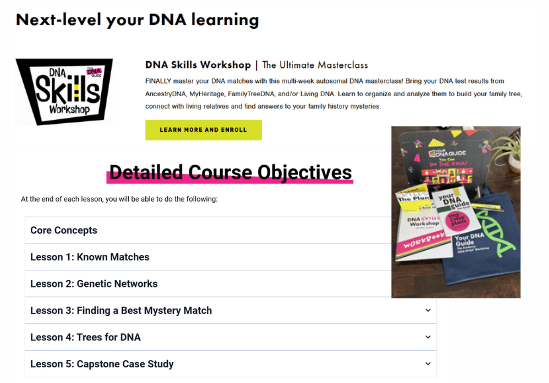
The DNA Skills Workshop, created by Diahan Southard, DNA genealogist, is a multi-week autosomal DNA masterclass that enables family historians to master their DNA matches through a virtual class platform.  I decided to enroll in the workshop to learn hands-on how my DNA test results could help to answer a family history mystery.

Features

The DNA Skills Workshop is 6 weeks of online interactive instruction, part of DNA Academy.  You have access to pre-recorded video instruction that you can complete at your own pace.  There are live virtual opportunities to have questions answered, to meet one-on-one with DNA coaches to discuss your own DNA questions and to review and practice what you have learned during 2-hour capstone case studies.  There are discussion boards available for comments and questions you may have as you progress through the course that are monitored by DNA coaches.  

You are also provided with electronic and print versions of Your DNA Guide – The Book and DNA Skills Workbook.  The Workbook includes classwork, homework, answers and a research log for each lesson module covered in the workshop. 

As a bonus, you receive the DNA Skills Swag Box that includes the book and workbook plus a bookmark, a brochure describing The Plan, Your DNA Guide pen and a tote bag.

Ease of Use

Accessing The DNA Skills Workshop was very easy.  All you have to do is use the Academy Login, which opens up to a page showing your courses.  You just click on the course icon to get to the course page.  This is where your course modules and anything related to the course are.  Navigating through the modules is straightforward, making it easy to complete them at your own pace.  

While the lessons are taught using a video format, Diahan Southard presents concepts by showing and telling.  Then, she expects you to stop the video periodically to practice what was taught.  This makes the learning experience hands on rather than passive. 

The curriculum is designed using Diahan’s proven SPIN process for what she feels helps you learn with more confidence:  Study, Practice, Implement and Next Steps.  This approach is better than just studying alone.  You actually by the end of the course have a better grasp on how to work with your DNA match results.

Support

The DNA Skills Workshop has excellent learner support with responsive and helpful DNA coaches available through live question and answer sessions, DNA Academy discussions after each lesson and one-on-one coaching.  Diahan also checks on your progress throughout your workshop experience.

Value For Money

This workshop’s pricing is not that unrealistic, considering how much time and money you could waste trying to get answers to your DNA questions.  Compared to other approaches to getting these questions answered, the DNA Skills Workshop offers exceptional value for its price.  I would definitely pay for the workshop again knowing what I know now.

Conclusion

Overall, the DNA Skills Workshop is a learner-friendly and effective solution to quickly find the answers to your DNA-related research questions.  It has helped me to move on with the DNA research piece of my genealogy project faster than I expected with exceptional support.  I would recommend the DNA Skills Workshop to any family historian or genealogist regardless of what level looking for ways to take down genealogical brick walls or to make the most out of DNA matches.

If you want to explore her website, go to yourdnaguide.com. To get more information about the DNA Skills Workshop specifically, https://www.yourdnaguide.com/dna-workshops is where you’ll find the below.