Review:  Methods Used To Organize DNA Matches

Picture this:   You’ve got over 10,000 DNA matches on one parent’s side of the family.  Only a couple really stand out as ones you know while the rest are a mystery.  How do you sort these matches out?  How do you organize them?

I realized there are different ways to organize or cluster them into groups, manually and using automation.  To summarize best what these ways are, I refer you to this blog post I found on Family Locket.  

Not mentioned in the Family Locket blog post is the AncestryDNA dot system which I learned about in the DNA Skills workshop (link here).  This blog post by Your DNA Guide should give you an idea of how that works.  While the AncestryDNA dot system does help identify clusters of matches sharing a common ancestor or ancestral couple, visualizing them is limited to just the DNA testing company’s website.  

I tried the Leeds Method and was excited about being able to create a Google Sheets spreadsheet that could be incorporated with the rest of my Google Drive genealogy content.  I liked the idea that I could also use the method using Ancestry’s Colored Dots but found this visually confusing when DNA matches sharing DNA with more than one color group created what is called overlap.  

Looking at the automated clustering options described in the Family Locket blog post, I didn’t care for visualizing DNA connections in a matrix within a chart.  It was too much, too fast, especially when I really enjoy the process of manually separating DNA matches into clusters.

After considering all of the above methods, I decided to start with using Ancestry’s Colored Dots to sort DNA matches into groups or clusters sharing a common ancestor couple.  I then worked on figuring out how I could create a DNA research log for DNA matches.  

Although I liked Family Locket’s Airtable approach to organizing and managing DNA matches, I admit I’m not a big fan of Airtable.  I’m more into Google Sheets.  So, I created Google Sheets spreadsheet templates, one for paternal DNA matches and one for maternal DNA matches, taking only the aspects I liked from Family Locket’s Airtable approach but making them more to my liking.  

My templates are a different way of logging DNA match research.  I name them DNA Ancestry Match Paternal Grandparent Groups Template and DNA Ancestry Match Maternal Grandparent Groups Template.  Each template has these key features:

  1. Tabs created for each grandparent:  Grandparent couples are separated into different tabs such that you can see which common ancestors specifically are shared amongst your DNA matches.
  2. Colors used are tied in with colors chosen for Ancestry’s Colored Dot groups or clusters.
  3. First column is frozen for ease of navigating the spreadsheet.

In summary. . .

There are different methods used to organize DNA matches.  Like managing genealogy research in general, you have to determine what works best for you and fits in with your workflow. 
How Does Ancestry Compare To ForeverⓇ?

I realize that Ancestry allows you to add files to a Gallery for a person on your Ancestry tree.  You can store those files there.  But, the Gallery isn’t a reliable place for storage.  If something happens to your Ancestry tree, then what you have in the Gallery may be lost.

You know I’ve mentioned ForeverⓇ as part of my system to manage my genealogy research.  You may wonder if ForeverⓇ can be used to store a family tree.  First of all I want to make it clear that ForeverⓇ is not a family tree builder.  

For example, you can’t store your GEDCOM there.  But, you can convert it to a PDF format that can be uploaded and stored in a ForeverⓇ digital storage account.  Forever is all about preserving your genealogy- or family history-related digital images and documents, not building your family tree. 

Another thing about Ancestry is that access to your Ancestry account is not forever.  It’s one of those “until death do us part” situations.  As long as you pay for the account subscription, you have access to it.  

Also, video isn’t allowed for storage in your Ancestry account.  Plus, storage is limited.  Photos are compressed.  This means when they’re downloaded from Ancestry, you shouldn’t expect them to be as large in size as you anticipate.

Ancestry access dies when you do.  Access stops when payment stops.  They don’t allow video.  They have limited storage.  They compress photos to take up less space.  As a result, when you download them, photo quality and size are altered.

As for ForeverⓇ, your account is literally forever.  You can store videos in your account and download them to play later.  If you go the premium video storage route, you can play them from your account directly.  You can even share videos with anybody by giving them a link which they don’t have to download. 

As for photo storage, photos aren’t compressed.  When you download photos from your ForeverⓇ account, you can expect full resolution quality.  They’re not compressed.  The size is what you expect. 

One last important fact about ForeverⓇ is you can get 2 gigabytes of free photo storage to start out.  Depending on your photo or image file size, that’s about 400 to 800 photos. 

You can get free ForeverⓇ storage along with a $20 coupon when you open up a new ForeverⓇ account at Forever.com.

Track Your Ancestors: Import Census Records into Spreadsheets

While I was doing brick wall ancestor research, I discovered a neat trick for keeping track of census data for direct-line ancestors and non-direct relatives alike.  I wanted to log census findings such that I could find them quickly for future reference when I needed them.

A Google search resulted in finding this gem:  A step-by-step guide on how to import census data into a spreadsheet.  Though this guide is created for Microsoft Excel, it can be applied to Google Sheets as well.  

I found the guide on YouTube and couldn’t wait to try it out.  After a few attempts at creating spreadsheets for census data with Google Sheets, it wasn’t that difficult.  I discovered that it was a lot easier to read the imported data than looking at the census itself for analysis.

The process I use now is creating a Google Sheets document and naming it with this format:  Year Country Census Surname Direct-Line Relative Couple.  This would look like this:  1910 US Census Doe/Smith

I then follow the steps to importing census data, creating separate tabs for each page.  I name the tabs Year PG # which would look like this 1910 PG 10.  

This spreadsheet gets saved in the folder containing research logs and other documents pertaining to the ancestor I’m researching in a subfolder titled Census.  If I want to retrieve it later, I know where it is in Google Drive.  If I don’t remember where it is in Google Drive, I can always do a search by typing in the keywords “surname census.”  

When I use census records for collateral research, instead of creating a separate spreadsheet for a non-direct relative, I may just add the data to a direct-line ancestor’s spreadsheet if they happen to live in the same area or location.  I just add a separate tab and name it Year PG # non-direct relative full name, which would look like this 1910 PG 8 John Buck.  

If you’d like to view the step-by-step guide on importing census data that I found on my Google search, click here for the YouTube video by Genealogy TV (Constance H. Knox) https://youtu.be/E2SJsANQ6zo?si=wuwwSF_7Zu8Mo7zb  Though it’s called “Extract U.S. Census Data into Excel to Find Your Ancestors in Your Family History Fast” the same method can be used for Google Sheets.  You can also purchase the handout at https://genealogytv.org/product/handout-for-extracting-census-into-spreadsheets-to-find-your-ancestors/  

ForeverⓇ Family Research Review:  An Expert-Based Research Solution

This post expands further on how ForeverⓇ Family Research helped me when I needed professional genealogy help.  From my post When You Need To Hire A Pro Genealogist , I mentioned that the Coaching Project Plan was ideal for the type of genealogy research I was working on.  I wanted to do the research myself while having professional genealogy guidance.

Here’s how the ForeverⓇ Family Research 3-Month Coaching Project Plan worked for me:

  • The professional genealogist reached out to me by email to schedule a time to discuss where I was at with my brick wall project.  By email I summarized what the project was, what I did accomplish and what I was stuck on.  
  • We then met via Zoom face-to-face for an hour.  This involved screen sharing and discussion.  This counted as my first month’s coaching session.  By the time the session ended, we figured out how we could approach it.  
  • I was given “homework” with detailed instructions provided during and after the session. I already had a Forever storage account and was able to access that month’s coaching  session summary.  The summary included what we discussed and my homework that was due by next month’s coaching session.
  • The next month’s hour-long Zoom coaching session focused on what I accomplished with the homework that was given.  We examined the results I got from obtaining a digital document that helped answer a research question.  We also went over other documents found since we last met.  
  • Again, I was given homework based on new goals set during the coaching session.  That session’s coaching summary was then loaded into my Forever storage account to access later.  
  • By the third and last month’s hour-long Zoom coaching session, a lot more about my ancestor was revealed than I anticipated.  It amazed me that I was able to uncover more than my initial research goal with the ForeverⓇ professional genealogist’s coaching.  I was curious as to how much more could be revealed.
  • Rather than get a ForeverⓇ Coaching Project Plan extension, to save me time I proceeded with the Research Project Plan for 3 months.  I was able to keep working with the same trained professional genealogist.  
  • Rather than me working on the project, the professional genealogist created a plan to carry out the project, looking into other records further and even translating them into English.  
  • Each month we met for a 2-hour Zoom session, which covered what was found and next month’s research plan.  
  • I received a monthly written report with that and research findings saved directly into my ForeverⓇ storage account for me to access at any time.  

How Easy Was This Service To Use?

Working with a ForeverⓇ professional genealogist for both types of project plans was easy.  The coaching project plan homework assigned was realistic, and the step-by-step guidance was straightforward.  I was able to learn hands-on skills that I can carry forward into future projects on my own. 

What About Support?

The ForeverⓇ professional genealogist was responsive and helpful with providing the research assistance I needed during Zoom sessions and brief emails between the sessions that I needed to send from time to time.  Monthly summaries were well written, making it easy to understand what was accomplished and what goals were set during the Zoom sessions.

Value For Money Spent

The project plan pricing is not that unrealistic were you to pursue hiring a professional genealogist and taking into consideration how much time and money you could waste trying to figure out brick wall issues alone.  Personally, I got a lot more than I expected out of both the coaching project plan and research project plan at just the 3-month increment for each.  

Overall, the ForeverⓇ Family Research genealogy plans are worthwhile purchasing to resolve genealogy research problems with professional guidance, quickly and effectively.  The results I received from the genealogy plans I purchased were beyond my expectations for each. 

When You Need To Hire A Pro Genealogist

After I did as much as I could at the intermediate genealogist level with my great-grandfather’s parent brick wall, I realized it was time to make an important decision.  Should I hire a professional genealogist?  Or, should I just be satisfied that I ruled out who was not his parents?

It wasn’t that easy for me to just simply be satisfied and let this brick wall remain.  I simply had to do something about it!  Especially when a cousin pointed out to me that there was a record worth looking into that was listed in the Social Security Application and Claims Index.  I was aware of it, but we both didn’t know how to pursue it further.

What I Really Needed

What I really needed was a coach at the professional genealogist level.  I had a strong desire to still “do the genealogy” but with a guiding hand and fresh eyes looking at this brick wall.  

This need was met through a company I’m affiliated with through their service, ForeverⓇ Family Research.  The service helps genealogy buffs or family historians with full-service research support, coaching or a one-time consultation.  

Here are the genealogy plans that ForeverⓇ Family Research offers:

  • Research Project Plans
    • A trained professional genealogist creates a full-service plan customized based on your specific needs.
      • The professional genealogist works with you to clearly outline your goals.
      • You begin your personalized research plan looking into records while working out family details.
      • You get help with brick walls, DNA interpretation or foreign language research to get needed answers.
      • You get a monthly written report and a virtual face-to-face meeting with the professional genealogist to guide you through the research and documents located each month. 
      • Findings are saved directly into a ForeverⓇ storage account for you to access at any time.  
      • You may wish to have a personal private ForeverⓇ Family Tree or invite the professional genealogist to have access to a tree you already have created to review with you and add to as the research project progresses.
    • Research Project Plans are available at 12-month, 6-month and 3-month increments.
  • Coaching Project Plans
    • If you just need some guidance and want to do your own genealogy research, a trained professional genealogist can help. Your guidance includes training and resource recommendations to provide you with skills and resources to design and implement your own research journey.
      • The professional genealogist picks up on where you are with your research to provide you with monthly customized coaching sessions.  
      • You are assisted with staying on task and prioritizing your goals while you learn hands-on skills as you progress.
      • Coaching sessions are monthly for one hour face-to-face virtually to discuss research goals, provide you with guidance through research approaches and available resources and recommended next steps to meet goals.
      • You get a monthly coaching report outlining what was discussed and resource recommendations plus your research task assignments.  This is added to a ForeverⓇ storage account for you to access at any time.  
      • You use new skills and resources to finish research task assignments while you do your own genealogy research on your own time before the next coaching session.
    • Coaching Projects are available at 12-month, 6-month and 3-month increments.
  • One-Time Consultation
    • If you aren’t ready to pursue a research or coaching project but have questions related to genealogy research or need some direction to get started, you can book a 1-hour consultation with one of the ForeverⓇ trained professional genealogists.
      • The consultation is done via online video chat.  
      • Topics for discussion:
        • Specific genealogy records
        • Recommended research approaches to make progress on your own
        • Understanding the basics of DNA
        • Strategizing solutions for your own genealogy research needs

What I Opted For

The ForeverⓇ Coaching Plan was perfect for me.  I opted for the 3-month increment plan, which was just right.  Within that timeframe I was educated about the Social Security Application and Claims Index record my cousin and I wanted to explore further.  

Following the steps the ForeverⓇ professional genealogist provided me, I was able to access a digital copy of the document, which answered a brick wall question.  This indeed was a genealogy research victory that was not that hard to achieve once I knew what to do.

Want To Know More?

If you would like to know more about how ForeverⓇ Family Research can help you, go to Forever.com.

If you would like to know more about my own personal experience with ForeverⓇ Family Research, click here.

How To Make The Most of Trello For Genealogy

You may or may not know what Trello is.  If you do, it’s an online tool to manage projects and tasks.  It’s a system using boards, lists and cards.  You can access it online or via an app on your phone.  

I’ve used it for quite some time but didn’t know how it would work for genealogy.  One day while doing some Googling for genealogy research organization ideas, I discovered that Trello could be used for genealogy too.  

Here are some of the ideas that my Google search generated for making the most of Trello for genealogy:

  • Create multigenerational family trees in a vertical list form, utilizing labels and/or card covers to show how people are related.
  • Log your research in the form of a workflow or a visual tracker to document what you’ve found and cite your findings.
  • Set up a genealogy planner board to house lists for research tasks to do and other activities not related to research.

Here are some online resources I found that were helpful to better visualize how I could tailor Trello to my genealogy research needs:

My Google search resulted in these boards in one workspace titled Genealogy:

  • Family History Book Plan
  • Genealogy Reference
  • Genealogy Courses
  • Genealogy Processes
  • Genealogy To Do
  • Research Log

I started out with creating the Research Log with these lists:

  • Goals
  • Notes
  • Waiting Room (pending contacts with DNA matches/relatives)
  • To Do
  • Research (Ancestor Name) To Do
  • Doing
  • Done
  • Parking Lot (backburner items for another research project)
  • Relevant Resources (websites that I use along with username and passwords kept in the description)

The To Do lists for an ancestor helped me keep in focus what information I already had on that person along with citations of sources and what I didn’t have.  The other lists helped me stay on task to finish DNA match-related projects.  

Eventually, I tailored my Trello boards for genealogy work in tandem with my Google Drive.  They keep me accountable to get tasks completed.  Having the ability to mark or move cards on from the Doing list to Done gives me a great sense of accomplishment. 

DNA Skills Workshop Review: A DNA-Based Family History Mystery Solution

The DNA Skills Workshop, created by Diahan Southard, DNA genealogist, is a multi-week autosomal DNA masterclass that enables family historians to master their DNA matches through a virtual class platform.  I decided to enroll in the workshop to learn hands-on how my DNA test results could help to answer a family history mystery.

Features

The DNA Skills Workshop is 6 weeks of online interactive instruction, part of DNA Academy.  You have access to pre-recorded video instruction that you can complete at your own pace.  There are live virtual opportunities to have questions answered, to meet one-on-one with DNA coaches to discuss your own DNA questions and to review and practice what you have learned during 2-hour capstone case studies.  There are discussion boards available for comments and questions you may have as you progress through the course that are monitored by DNA coaches.  

You are also provided with electronic and print versions of Your DNA Guide – The Book and DNA Skills Workbook.  The Workbook includes classwork, homework, answers and a research log for each lesson module covered in the workshop. 

As a bonus, you receive the DNA Skills Swag Box that includes the book and workbook plus a bookmark, a brochure describing The Plan, Your DNA Guide pen and a tote bag.

Ease of Use

Accessing The DNA Skills Workshop was very easy.  All you have to do is use the Academy Login, which opens up to a page showing your courses.  You just click on the course icon to get to the course page.  This is where your course modules and anything related to the course are.  Navigating through the modules is straightforward, making it easy to complete them at your own pace.  

While the lessons are taught using a video format, Diahan Southard presents concepts by showing and telling.  Then, she expects you to stop the video periodically to practice what was taught.  This makes the learning experience hands on rather than passive. 

The curriculum is designed using Diahan’s proven SPIN process for what she feels helps you learn with more confidence:  Study, Practice, Implement and Next Steps.  This approach is better than just studying alone.  You actually by the end of the course have a better grasp on how to work with your DNA match results.

Support

The DNA Skills Workshop has excellent learner support with responsive and helpful DNA coaches available through live question and answer sessions, DNA Academy discussions after each lesson and one-on-one coaching.  Diahan also checks on your progress throughout your workshop experience.

Value For Money

This workshop’s pricing is not that unrealistic, considering how much time and money you could waste trying to get answers to your DNA questions.  Compared to other approaches to getting these questions answered, the DNA Skills Workshop offers exceptional value for its price.  I would definitely pay for the workshop again knowing what I know now.

Conclusion

Overall, the DNA Skills Workshop is a learner-friendly and effective solution to quickly find the answers to your DNA-related research questions.  It has helped me to move on with the DNA research piece of my genealogy project faster than I expected with exceptional support.  I would recommend the DNA Skills Workshop to any family historian or genealogist regardless of what level looking for ways to take down genealogical brick walls or to make the most out of DNA matches.

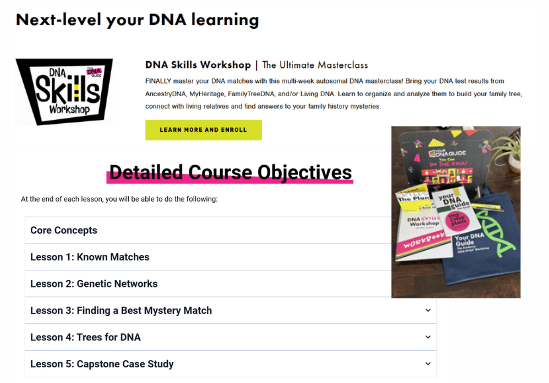
If you want to explore her website, go to yourdnaguide.com. To get more information about the DNA Skills Workshop specifically, https://www.yourdnaguide.com/dna-workshops is where you’ll find the below.